• Home
  • About
    • Copywriting
    • Brand Messaging
    • Studio Sessions
  • The Ampersand
  • Contact
Menu

Stark & Splendor

Street Address
City, State, Zip
Phone Number
Copy And Brand Messaging Studio

Stark & Splendor

  • Home
  • About
  • Services
    • Copywriting
    • Brand Messaging
    • Studio Sessions
  • The Ampersand
  • Contact

Heritage and the stories we like to tell.

March 21, 2016 Stephanie
Vintage Levis
Vintage Levis

Branding experts like to talk about storytelling as the shortcut to relevance and meaning.

I agree. Narrative -- even small ones like the one depicted in this vintage ad -- is a powerful way to communicate a brand's deeper values.

But recently, I've seen it go terribly wrong when young companies reach for origin stories that simply aren't there, or when they stretch the meaning of the words heritage, craft, heirloom, and artisan.

Yesterday'sEmerald Streettakes on the subject brilliantly. Here's the gist:

"There are more and more brands trading on any sort of history they can muster. Labels like Hunter, who do really have a heritage, shout about their lengthy backstory and consumers go wild for it. Spanking new brands, the ones that were dreamed up yesterday, do the same and are pretending to have “heritage” ideas and aesthetics."

I've noticed the same thing, and it makes me want to shout from the rooftops:

You don't need an ancient or romantic backstory to have a great product and build a great brand.

You really don't.

All you need is to solve a real problem for a specific group of people.

Collect the stories of the uncommonly common ways you're changing their lives, and you've got the basis for powerful brand storytelling.

It's simple, but it's not easy. Even huge international brands get seduced by the possibility of inauthentic provenance claims.

To me, nothing drives the point home better than this oldie but goodie video.

[embed]https://www.youtube.com/watch?v=TBb9O-aW4zI[/embed]

We laugh because we've all seen this done!

The moral of the story is: think twice before building your brand around the notion of heritage, craft, or any other trendy idea that signals quality or difference.

"Est. 2016" might mean something to your customers in 20 years, but what's the more true story you can tell now?

I bet you have an awesome one. Let's tell it together.

In Fun, News, Thoughts, Tips Tags Brand Messaging, Branding, Copywriting, Positioning, Storytelling
Comment

Book Review: Meaningful by Bernadette Jiwa

February 10, 2016 Stephanie
Meaningful 2
Meaningful 2

Bernadette Jiwa is one of my professional heros. The woman speaks my language... or perhaps it's me that speaks hers, since she's influenced Stark & Splendor in so many ways through the gold that she posts on her blog, The Story of Telling.

She was the first marketing expert that articulated what I intuitively knew to be true: love and empathy are, in fact, some of our most powerful strategies for winning in today's noisy, cluttered, staticky digital world.

The most recent gold that Bernadette has dropped into my lap is her newest book, Meaningful: The Story of Ideas That Fly. The basic premise is that we as marketers and business owners often approach the innovation process backwards. We tend to start with an idea that we love, and then spend our budgets (and break our backs) trying to get others to love it too. All the while we think, "there must be an easier way!"

Meaningful charts out the path of lesser resistance.

What if we started with the customer's story? What if we understood what was meaningful to them and only created in alignment with that insight? What would innovation look like? How would our marketing change?

Meaningful_1
Meaningful_1

Excerpts

On relevance....

"Just as the best stories change the people who encounter them, the brands businesses, movements, products and services that succeed by being meaningful change people too. There is a life and a way of being before the product or service existed, and a life and a way of being after it."

"...if there is no change in the customer, there is no innovation."

On marketing today...

"Marketing has gone from this...

Awareness --> Attention --> Action

...to this...

Attraction --> Affinity --> Action"

On cause and effect...

"When we encourage people to believe that something matters, we attract the kind of people who care about that something. Soon buying from us becomes part of their identity--their story. The experience--our posture and products, and the story the business owner is inviting the customer to buy into--is what creates the customer."

On emotional capital...

"We have come to care about all parts of the buying journey as much as we care about ownership."

On old rules of brand awareness...

  1. Make something for everyone.
  2. Tell our story.
  3. Attract customers.
  4. Build brand awareness.

On new rules of brand awareness...

  1. Understand the customer's story.
  2. Make something they want.
  3. Give them a story to tell.
  4. Create brand affinity.

On story...

"People...want to become invested in the businesses and brands that they choose to support, and they want those brands to be a part of the stories they tell both to and about themselves."

On love...

"I'm here to tell you that giving a damn is seriously underrated and caring is a competitive advantage."

How legit is this woman? I could go on and on sharing excerpts, but the most practical part of the book is Bernadette's framework for "giving a damn." It's called The Story Strategy, and in Meaningful she models how to use it by applying it to the innovation journey of a bunch of wonderful brands that we all know and love...Go Pro, Canva, Harry's, and Khan Academy, to name a few.

The Story Strategy
The Story Strategy

The Story Strategy can be applied to product R&D and organizational strategy, but it's also so instructive for specific marketing communications campaigns, copywriting or content creation.

I've been using it a lot and have found it to be a wonderful tool for getting me focused on the customer's story first and foremost.

I would heartily recommend this book to anyone that is a student of branding and/or is intent on creating things of consequence in this world.

Have you read Meaningful? What'd you think? What's currently on your nightstand?

In News, The Ampersand Tags Book Review, Branding, Marketing, Strategy
4 Comments

Re-thinking Mission & Embracing Purpose.

January 21, 2016 Stephanie
Uncovering Why. Rethinking Mission and Embracing Purpose.

Today I want to talk about one of the most important aspects of assembling your brand messaging: purpose.

Purpose is at the top of the agenda when I sit down with clients to craft their messaging and it’s a great topic to revisit at the beginning of the year.

Purpose is the “why” that lends meaning to the “what” of what you do. Purpose reveals your motives, and motives are important because they reveal your values.

Besides the tangible solutions you offer through your products and services, values are the #1 thing your audience buys when they buy you.

If your values [as revealed by your purpose] align with your audience’s, then the skies are the limit to what you can build with your customers!

So, it goes without saying that defining your purpose is hugely important. Like a compass points a captain to true north, a crystal clear purpose points to the ideas, innovations, and intentions you should pursue to make your customers' lives better.

But let’s clear something up:

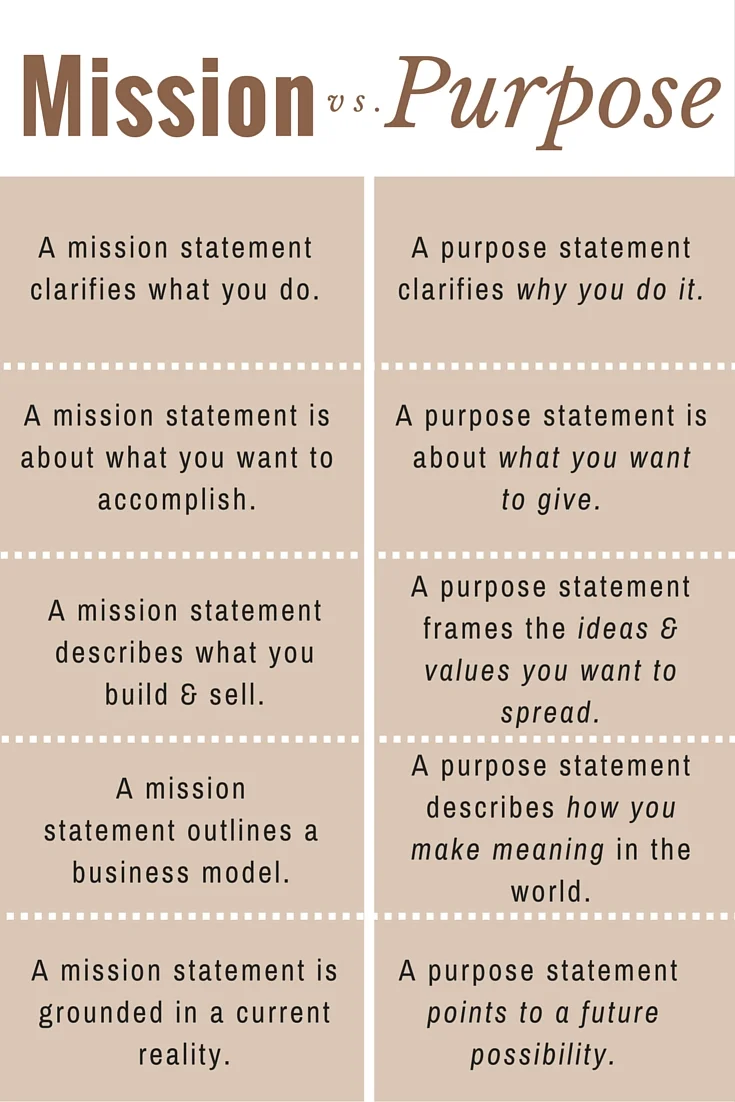
Having a purpose and having a mission statement are two different things.

Here's my take on how mission and purpose differ:

Mission vs. Purpose

Anyone can have a vague, formulaic, jargony statement about being “best in class by redefining the industry with leading-edge technology that disrupts the status quo.”

I bet you’ve seen hundreds of these! At best they're a bore, at worst they're empty words.

Don’t get me wrong: codifying your day-to-day mission is very important for your internal audiences. It gets everyone on the same page, and that's a worthy goal.

But no one ever waited in line for 12 hours on release day, or edited a fanzine, or hosted a viewing party, or bought the t-shirt for a brand that was purposeless, but awesome.

Nope. Customers bend over backwards for a brand only when they feel connected to its purpose and aligned with its values.

Perhaps this is why I’ve noticed more and more organizations de-commissioning tired ol’ mission statements from their websites in favor of purpose-driven language instead?

If you’ve never thought about your organization’s purpose or haven’t revisited your “why” in a long time, then this is my A-1 tip for strengthening your brand.

Give yourself a few days to answer these questions to flush out your purpose and uncover your "why."

10 Questions for Uncovering "Why" & Embracing Your Purpose:

  1. What do your customers want to do that they either can’t do or find difficult to do?
  2. How can you fix that?
  3. Why do you want to fix that?
  4. Why are you the one(s) to take this on?
  5. What happens if you succeed? What difference will it make?
  6. Why does that difference matter?
  7. What do your customers believe about the world? – Life, love, happiness, truth, etc.
  8. What do you believe?
  9. What do you know for certain that you wish everyone could know?
  10. If everyone knew what you know, how would the world change?

Mull these over and write down your answers. It doesn't matter if they're messy or nonsensical at first. Just get them down on paper. When you’re ready, take a stab at writing a statement of purpose that hits on the six elements in the Mission vs. Purpose graphic above.

Pro Tips for Writing Your Statement of Purpose:

- Don’t be overly formal.

- Have fun with the words, phrases, or word-pictures that you use.

- Play around with tone. Is your brand optimistic, maverick, pensive, blunt, feminine, masculine, aspirational? Insert tone-specific words to stay on-brand.

- Keep it short and sweet. Meaningful doesn't have to be long.

- Lastly, don’t rush to put your statement up on your website – sit with it for a few days and think about how you can let this language shape how you talk about your products, services, and brand.

Need Some Help Clarifying Your Purpose?

This series is a great primer but if you want one-on-one support for crafting your brand messaging, the Articulation Intensive might right for you.

In this 4-to-6-week program your and I will craft words and ideas that express your brand's purpose and personality.

To chat about your brand messaging needs, contact me at steph@starkandsplendor.com.

In Inspiration, The Ampersand, Thoughts, Tips Tags Brand Messaging, Branding, Mission, Purpose, The Articulation Series
Comment
← Newer Posts Older Posts →

© 2017 Stephanie Sinnema Consulting (PTY) ltd. All Rights Reserved.
A legal word or Two